

Finally, 17 February 2025 arrived and we were definitely ready to leave for our expedition trip to Antarctica.
 City lights of Rio de Janeiro from the air
On the way there we were stopping in Rio de Janeiro for a couple of days. We had planned to visit this city in March 2020 when on a cruise around South America, but this was cut short due to the outbreak of Covid-19. The plan had been to finish our cruise in Rio and fly home from there but this was not to be. I was really disappointed as the opportunity to see the statue of Christ the Redeemer had been on my bucket-list for many years. Now the opportunity was once more there, so we decided to take it.
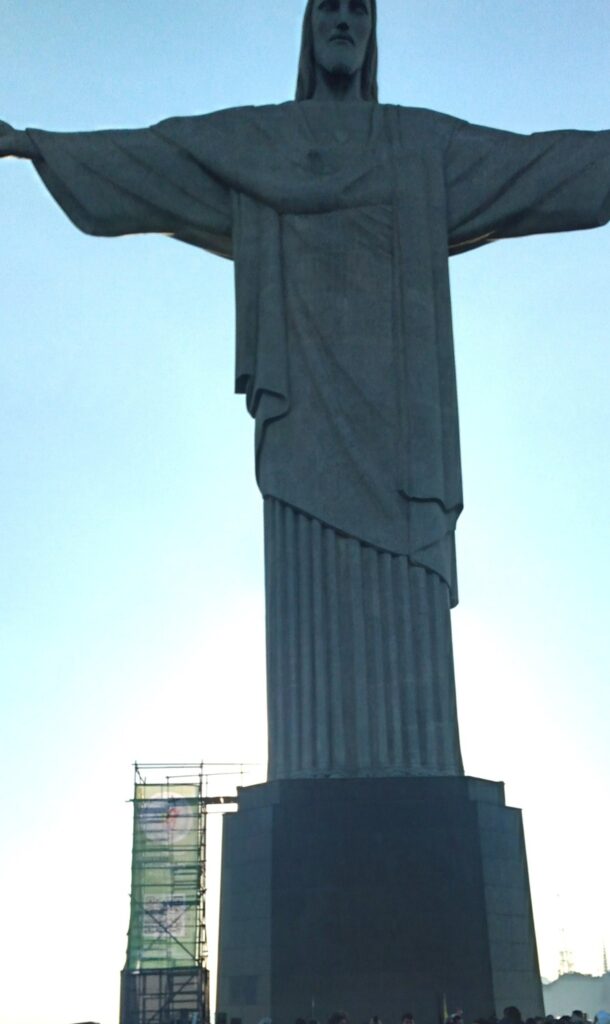
Statue of Christ the Redeemer
We had to be up early for our first flight at 08:00 and there were 2 more after that – Durban to Johannesburg for 1 hour; Johannesburg to Sao Paulo for 12 hours and then Sao Paulo to Rio for 2 hours. Added to this we gained 5 hours which meant that from the time of waking until reaching our hotel was almost 20 hours.
We flew into Rio de Janeiro at 20:45 and the view of the lights of the city were quite beautiful. It was only the next afternoon that we learnt that the airport runway started and ended at the harbour’s edge. Walking through the airport we saw 2 striking murals, one of a gentleman and the other a young lady, On doing some research I learnt that the gentleman was Alberto Santos Dumont, a Brazilian born in the late 19th century. He was known as the inventor of the airship and amazed leaders in Europe and the USA with flights of his airship. There was no information on the painting of the young lady, nor could I find any through the internet. It was probably no more than a beautiful painting.


On waking and having had a good breakfast the next morning, we decided to walk around the area where the hotel was situated, which was in a lovely leafy street.

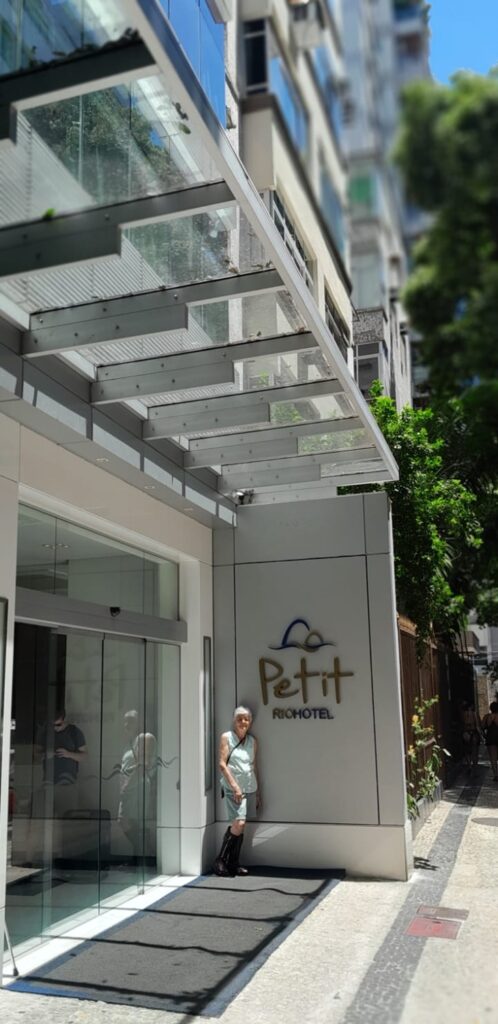
It was a middle to lower income area with lots of street vendors selling everything from toys and sweets to clothing and items for mobile phones. There was no pressure from the vendors to purchase their wares and we noticed very few people shopping.

 Protestant Church further down the road
We had booked a sunset cruise around the harbour for later in the day and had been told that, to get to the marina, we would need to take the underground train. We were pleased to find the station within easy walking distance of the hotel. As we wandered, we went into a local supermarket which was small but well stocked. We bought something for lunch and continued in the scorching heat. At the end of the street was a furniture store and mattresses were sold here. Not surprising really but what did catch our eye was how they were transported. This was on a specially designed bicycle with a long, flat ‘shelf’ at the front allowing for up to 3 mattresses to be transported at a time. We saw on a gauge that the temperature was 390C so we were glad that we had packed suitable clothing.

Mattress delivery bikes and proof that the temperature was 39deg C
We returned to the hotel soon after lunch to have a shower and change in time to take the train to the marina. On arrival at the subway, we were pleasantly surprised to learn that, as we are over 65, we did not have to pay to use the train. Taking the train just one stop to Gloria Station was easy but getting to the marina was anything but! Firstly, we learnt that very few people in Rio speak any English and not many have any desire to assist people either. It seemed surprising as there were so many American tourists there. At one point we asked a gentleman but he didn’t know where we had to be even though it was written down on the booking ticket. It was then that I saw a taxi driver sitting in his car with the door open. As soon as he saw me walking towards him to get assistance, he slammed his door closed. Similarly, the Police and Security personnel were very unhelpful. After being sent in various directions we finally reached the marina and found the meeting place, very pleased not to be late for the 1.5hour cruise.
All this being sent in different directions and, as frustrating as it was, it did take us past a park which peaked our interest in a statue, a bronze bust built next to a tall monument and a fascinating tree root. The statue was that of São Sebastião, also known as Saint Sebastian, a revered figure in Brazilian culture, particularly in Rio de Janeiro. In the 3rd century he was a Roman soldier who converted to Christianity and was later martyred for his beliefs.

The bust was of Getulio Vargos who President of Brazil twice, in the 1930s and early 1940s and then the first 4 years of the 1950s. The Monument was built by the local Municipality in his honour.

Then the tree root. While sitting on a bench I noticed a root growing out into the pavement and then back inwards toward the tree from where it had originally come.

We were surprised to learn that there were only about 30 persons on the boat as it was quite large. Then, of course, it was not holiday season. There were 5 crew members – the fellow who met us on arrival and recorded our attendance, a woman selling snacks, the boat pilot and 2 other young men whose purposes were not really clear.
As mentioned above, the airport runway begins right on the harbour wall and we were so fortunate to see a plane coming right over the boat to land.

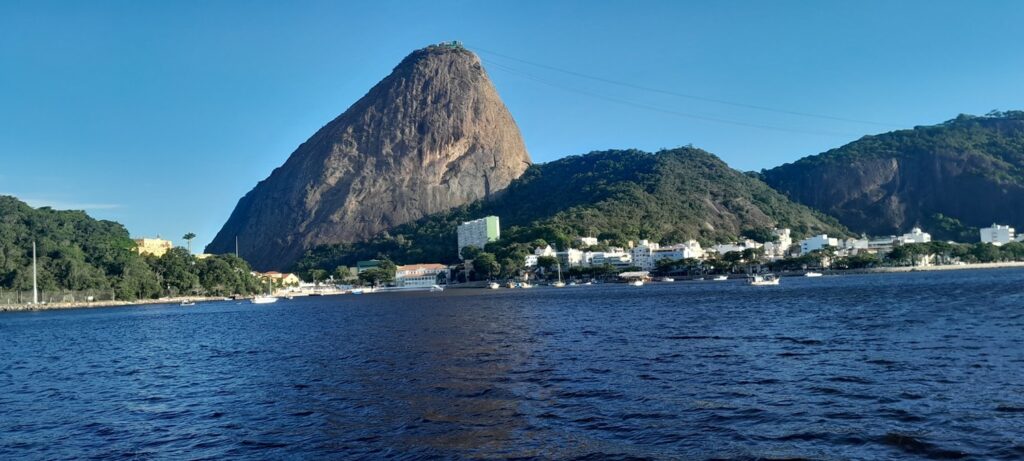
It was a most interesting and informative cruise, getting to see many fine buildings, a 13-km long bridge, seen in the photo above, linking the 2 sides of the harbour and we got our first glimpse of, not only the statue high up on a hill but of the Sugar Loaf Mountain as well. This is a name that had always fascinated me and it was interesting to learn that mountains in the area are named for their shape. At one time, sugar was not dried and crystallised but kept moist and packed to look like a loaf and this mountain appears to look very like one of these loaves.
We made a 10-minute stop at the Rio Museum of Tomorrow, a truly beautiful and unusual building which looks like a spaceship. It is extremely large but beautiful. It was designed by the Spanish architect, Santiago Calatrava, and is situated on the Maua Pier very close to the water’s edge. We were able to get photos of the building, only parts though, so I have included a photo from the website.


We also saw another museum, the Oscar Niemeyer Museum of Contemporary Art, situated high on a hill and with an annex shaped like a human eye. It is affectionately known as the MON, Museo of Oscar Niemeyer, who was the architect. He was 95 when he designed this building.

At the end of the cruise, we asked the crew member who had met us at the marina, he spoke English, the easiest route to Gloria Station. He strongly advised us not to walk to the station nor even, to the hotel from the subway, as there are young men who prey on pedestrians once darkness falls. He said that their main form of attack was to climb the trees and pounce on passers-by. Based on this advice, we took a taxi back to the hotel and had an early night.

